Showing posts with label St. Augustine. Show all posts

Wednesday, July 31, 2013

El Galeon The Sailing Ships of Spain

I recently attended a celebration of the 450th anniversary of the founding of St Augustine Florida with my photography group. There were no bands or fireworks but the big attraction was a working replica on the 16th Century sailing ship El Galeon. These were the ships the Spanish used to bring in provisions and haul off gold and other materials from the new world. The ships were fast and carried big guns to defend themselves from pirates or other countries that might try to take their treasures. As usual, click each photo for a better view. 


The El Galeon was representative of the sailing ships of the era. The Galeon was a scaled down version of the Carrack ships which were primarily fighting ships. The smaller size of the Galeon  allowed it to serve a dual purpose of transport and fighting ship.

Despite the history of the ship type, what really fascinated me were the various knots required to work the sails and swiftly move the ship from port to port. Sailor's knots were an essential for any crewman worth his wages. Knowing the knots allowed the ship to effectively use the wind at a time when there were no machines and understanding how to manipulate the elements was a major achievement. There were 40 basic knots that every sailor needed to learn. You might sign on as a cabin boy and begin your training that way, or learn the skill to pass the time during long voyages as a form of entertainment. Sailors learned to use knots to make almost anything that could be held together by the knots. 


Ropes were the glue that held the sails in place, allowed sailors to climb the mast, secured the cannons, in addition to allowing men to move heavy treasure with the use of various pulleys. Ropes did it all and knowing how to tie the knots to make it happen gave a sailor a trade.


The Galeon was a narrow ship, so close quarters were the rule of the day. The Captain and Senior Officers  were part of a cast system that allowed them small creature comforts that were better than the rest of the crew. But, after so many days at sea, you have to wonder if it really mattered. They too were subject to knowledge about knots. Their very lives might depend upon it.


This map show the areas of exploration and dates. circling the State was a major undertaking and it becomes apparent the Spanish were actively involved, through various expositions, in the exploration of Florida from 1513 until 1565. Their skill at sailing the fast ships gave them an early foothold in the new world.


You truly had to admire the bravery of these men because the work was hard, conditions were quite rough, and if you made a mistake in the knot making skills needed to move the ship, the chances were good that you would not return to friends and family. It seems amazing now that something as simple as learning to tie a knot was a major factor in  creating what we now know as St. Augustine and the United States.


Thursday, July 8, 2010

The Hidden Jewel of St. Simons Island

Alex and I decided that we had been working much too hard and needed a break. And now I am going to surprise you and say we decided to go to the beach... outside of Florida!


We had heard a little about St. Simons Island and it seemed perfect in that it is a little over an hour away, is in another state so we could say we did a little interstate travel, and of course it would provide a chance to take some pictures! As usual, click on each photo for a better view.

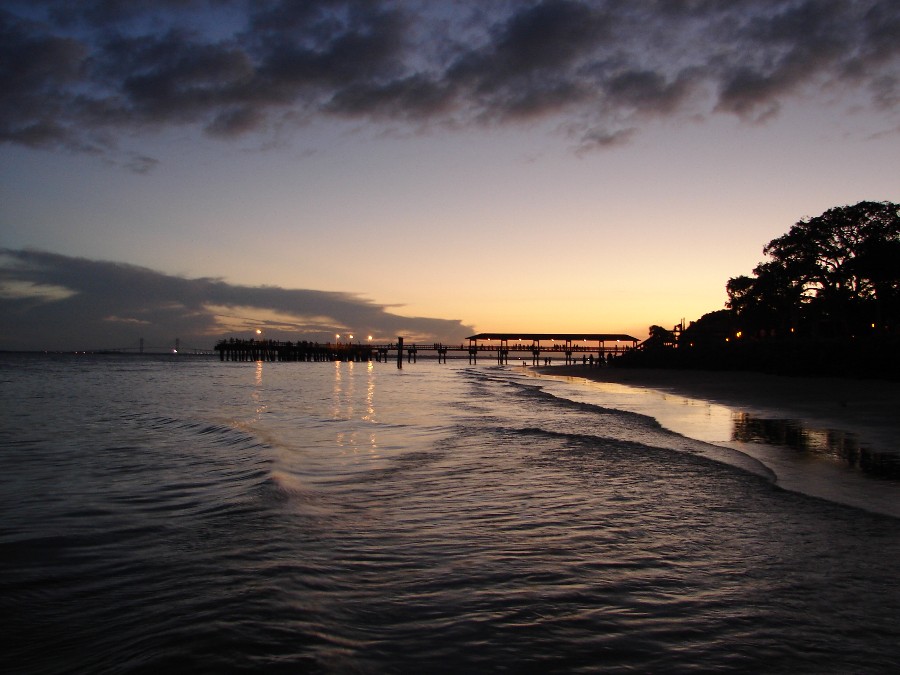
We struck out with me playing the female Willie Nelson singing "On the Road Again" during the drive. The picture above is a pier we encountered which really amazed us because you normally do not think of beaches and piers when you think of Georgia.

To enter the island you have to cross this interesting bridge. I snapped this shot from the car. The suspension section at the top reminded me of sails on old sailing ships.


And after some discussion regarding directions, we saw the sign telling us we were going in the right direction.


After reading a little history of the area we discovered it was settled by the Spanish who took the name from inhabiting Native American dialect, and Fort St. Simons was built in 1738 under the command of our good friend General James Edward Oglethorpe. The fort was built to protect the entrance to the Frederica River where ships had to pass to reach Fort Frederica. At the time, the tip of St Simons Island was the most heavily fortified area in Georgia. The fort was later destroyed by the Spanish in 1748 (sounds a lot like the history of St. Augustine with the area changing hands back and forth between the English and the Spanish). Now, the area serves as a beach resort...


and one of the main attractions is the light house that long ago guided ships into the area . We discovered we were in luck, because the light house had been refurbished in April of this year and was presentable for all manner of picture taking.


I took a close-up of the globe lamp or lense which you should remember from our visit to the St Augustine Lighthouse.


One thing I really liked about the place was that bicycles and golf carts were the preferred mode of transport around the island so we felt right at home riding our bikes. There is a more personal feel to the place when compared to St. Augustine and the hotels and bed and breakfast houses blend into the charm of the area. This little hotel is a perfect example of the quaint feel of the place.


At night the island seems to take on an almost magical feel. A dusk view of the lighthouse seems very different from the view during the day.


Here is the globe in all it's glory...


Even the trees seemed to take part in the glorious dance of the night. Alex and I were walking along the beach, turned... and there they were!


And finally, my best shot of the adventure was taken as we walked near the water's edge. It seemed like a perfect end for the day. We both felt calm and rested and resolved to return for many more adventures to come...


Thursday, May 13, 2010

There is Something About a Balcony

I promised pictures of a few interesting houses we encountered in St. Augustine and as I promised here is the post. Some of the houses do not have one but a defining feature that really interested me was the balcony. As usual, feel free to click each photo for a better view.


What I discovered as I took these shots is that balconies are a throw-back to a time before air conditioning and our retreat into our own little isolated boxes. They offered an escape from the heat of the house, a chance to display your creativity in making the space your own, as well as a chance to interact with your neighbors as they strolled in the streets or enjoyed their balconies as well. I call the picture above "the plain house" because nothing has been done to it and the house has actually been abandoned. I know because we snooped and looked through the windows and it is loaded with furniture that is covered with layers of dust.


A good number of these houses have wrap around balconies which I find really appealing. This one I have titled the "Mark Twain house" because I could imagine Huckleberry Finn running out of the door and off to some new adventure.


This one does not have a balcony but is simply interesting because it is so weathered. As I said in an earlier post: it screams "mystery". Each board and plank looks as if at any moment it will crumble into dust and blow away, but somehow it has stood for a long, long time.


The owners of this house "the pink house" have added flowers and seating and created a small oasis to while away the evenings.


I really liked this shot of another pink house further down a side street because there is the contrast in color of the back of the stairs, the pink of the house, and how they move the eye up to the balcony.


An finally, a full view of the" secret garden house". The unseen elderly lady or young couple have truly made this their own by continuing the garden theme on the balcony. I really like the way they have kept the old world feel of the house and the overgrown garden puts a fine point on that theme.


The point of these pictures is that despite the fact that we and most tourists regard St. Augustine as our play ground, it is actually a place where real people live and go about their daily lives. I say that because just as these balconies were designed to do they helped us interact with a number of people...

Thursday, November 12, 2009

The Light at the Lightner Museum, Part II

I am always amazed when you go looking for one thing and find another. I mentioned in Part I that Alex and I were simply looking for an afternoons entertainment and decided to go to the Lightner Museum to take pictures. We discovered one entire floor is dedicated to all types of glass and in particular the stain glass of Louis Comfort Tiffany.

Born into the wealth of the Tiffany diamond family, he was an interior designer who wanted glass to transmit texture and rich color. When he could not get them he opened his own foundry to create them from 1848 to 1933. His inventiveness both as a designer of windows and as a producer of the material to create them caused him to develop a type of glass he called Favrile. The trade name Favrile was derived from the French word, fabrile, meaning handcrafted.

Favrile glass possesses a type of iridescence which causes the surface to shimmer as well as a degree of opacness. This iridescent effect was obtained by mixing different colors together while hot. The result would make him renound the world over for some of the most beautiful stain glass windows ever to be produced.


I call this piece "angel" because I forgot to take pictures of the actual names which allowed me to keep track of the titles. There was simply so much to see you almost become overwhelmed.

I like how it seems to float in the black background and the colors are both soothing and amazing.


Next is an Art Nouveau window that would have provided any parlor of the time a great deal of light and was what we would have considered very fashion forward.


For the music lovers of the time you could have Beethoven providing a bright shining light just above the piano for inspiration.


And the piece that everyone fell in love with when I used it on the other blog. The sight of it almost forces you to take a moment for restful contemplation.


A little side note to history. In researching Tiffany and of course the Tiffany Lamp I discovered Clara Driscoll who was the Director of the Tiffany Studio's Women's Glass Cutting Department. It has recently been discovered that "The Tiffany Girls", led by Clara Driscoll, chose the colors and types of glass used in the Studio's famous glass items which gave them more life and movement and ultimately more popularity.


Also as the creative force behind the Tiffany lamp, she was the designer and craftsman of more than thirty famous lamps. Sadly as a widow she worked for Tiffany for more than 20 years but once she remarried in 1909 her career ended because married women were not allowed to work at the foundry.


The following two stain glass windows are so beautiful they almost take your breath away. It is a feast for the eyes as you find yourself visually roaming each piece.


And finally the lovely Marie who works at the Museum and gave us tips on where to find some of the wonderful items you see here.


Despite the fact it was Sunday and late in the day, she was cheerful and full of information. And, she seemed to genuinely want to make sure you enjoyed your visit.

All in all this was one of the most difficult posts I have ever had to do. There was so much to see and most of it was so amazing that the hardest part was deciding what to include and I still did not come close to giving you a real feel for the place. If you are ever in Florida and near St Augustine it is truly a "must see."

Tuesday, October 6, 2009

Mayport, An Overlooked History

A friend recently invited me lunch at a little restaurant called Safe Harbor in Mayport Florida. Mayport is a little fishing village near Jacksonville and since I had heard a little about the place, I welcomed the chance to go. As always, click each photo for a better view.


I was surprised to learn that scholars believe Jean Ribault landed in Mayport in 1562, which predates both St. Augustine and Jamestown. And, as you can tell from the condition of the sign above, St. Augustine has capitalized on its history and Mayport has not.


The Safe Harbor restaurant sits on the river and offers fresh seafood and a view of the fishing boats. It is simple dining but great atmosphere.


And it is a fantastic view. But it also shows that the adage about location being very important does you no good if there is a lack of vision once you get there.


I say that because there does not seem to have been much of an effort to capitalize on the historic nature of the area and now cruise ships have begun to take over the harbor.


Cruise ships and birds now pretty much own the place.


The food was quite good and as we sat outside and watched the fishing boats come and go it made for very pleasant dining.

I could only wonder what the place would look like if there was a significant effort to highlight the natural beauty of the place.


I watched this fishing boat pull away from the harbor with nets ready for the next catch.


And then had to smile as it reached the middle of the river. If you look closely to the right of the picture you will see a cloud of birds following it out of the harbor. They too were ready for the next catch. At least someone in the area knows how to capitalize on potential opportunities.

Wednesday, August 12, 2009

The Melting Pot of St George Island Florida

Another weekend and another adventure. This one close to home but in a more northern direction from the usual jaunt to St Augustine. And yet St George Island has just as much history as St. Augustine with rich relics of the native population that inhabited the area and numerous tales of the back and forth ownership between the Spanish, French and British. Couple that with a roaring 20's seaside resort and you have the makings of a really good story. As always, click each photo for a better view.


Nothing embodies St George Island more than the Ribault Club which was a high end resort during the 20's and is now a cultural center for the island. It is on the same stretch of the island as the Kingsley Plantation and has a great view of the inlet.

Entering the main building, you are instantly transported back in time to the era of flappers and grand parties. I could imagine young people back then sitting in these chairs listening to music or some radio program.


Or this long hall, it must have all kinds of stories to tell about conversations that occurred leading to the ball room at the end. One can just imagine great parties and flappers in this corridor.


I could not resist taking a picture of these dark golden chairs that seemed to occupy a special place in the hall. There was something old and beautiful about them in that spot.


The major difference between this region and St Augustine is its emphasis on the native population that inhabited the area along with the British,French, and Spanish. One whole side of the resort is dedicated to the island's ever changing history...


and how the club came to be named Ribault.


The beauty of the place truly amazes you and has numerous spots for you to stop and just take it all in. There is a plaque tribute to a local environmentalist that sits at the base of this oak tree. The tribute invites you to take a moment, sit down on the bench and soak in the calm of the area.


And finally, this little church caught my eye on the drive out. It is a classic example of Carpenter Gothic (steep gable roof, narrow rectangle shape, pointed windows and bell tower) which used local materials and was the preferred form of construction in the area after the civil war until 1924.


But, it is only once you walk a little around the side that you realize just how narrow the church actually is.


And there you have it... St. George Island and the Ribault Club!